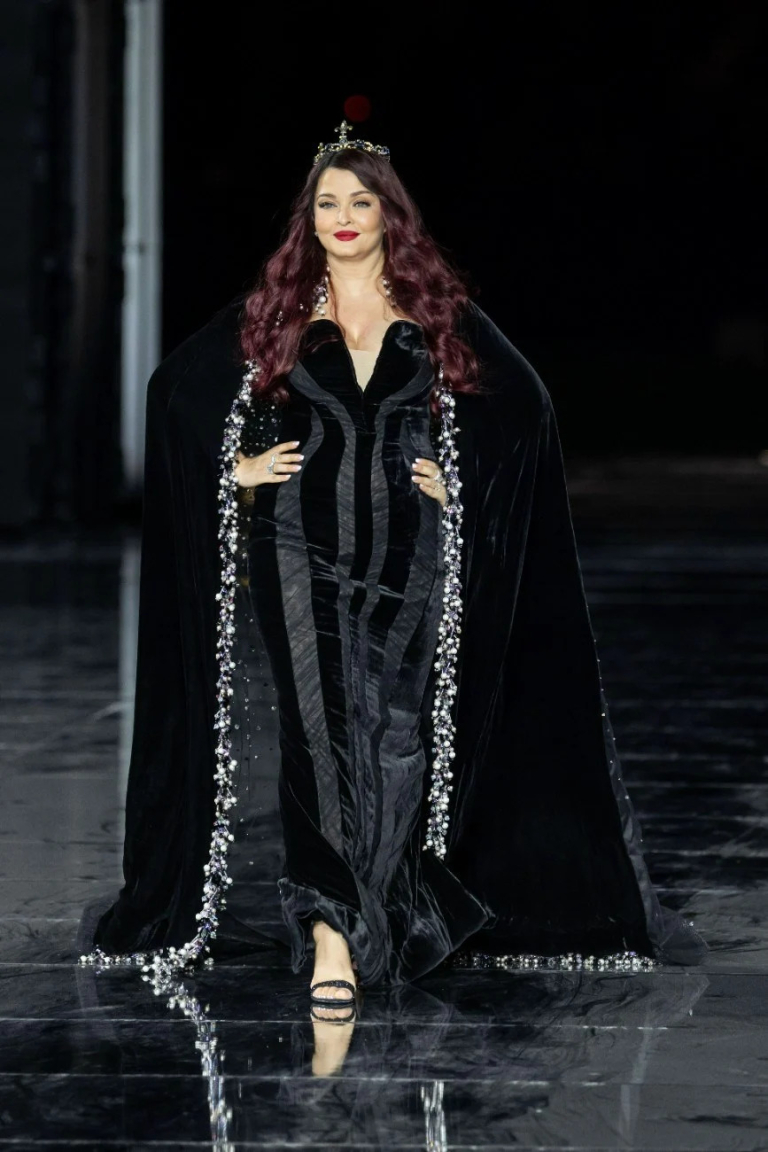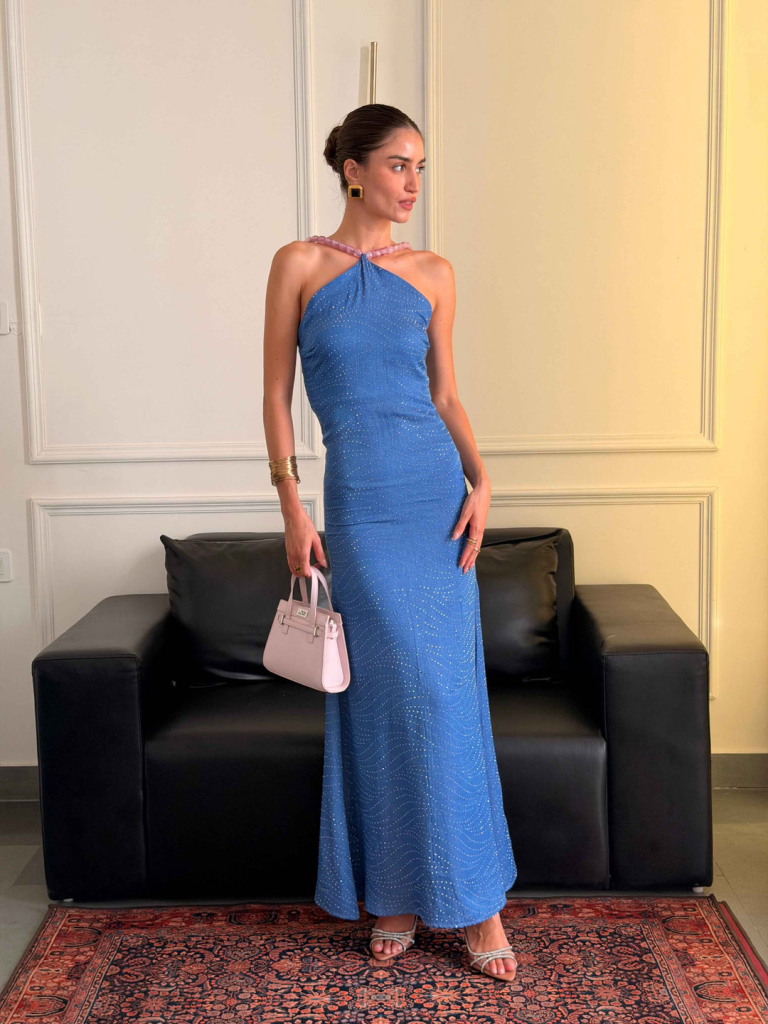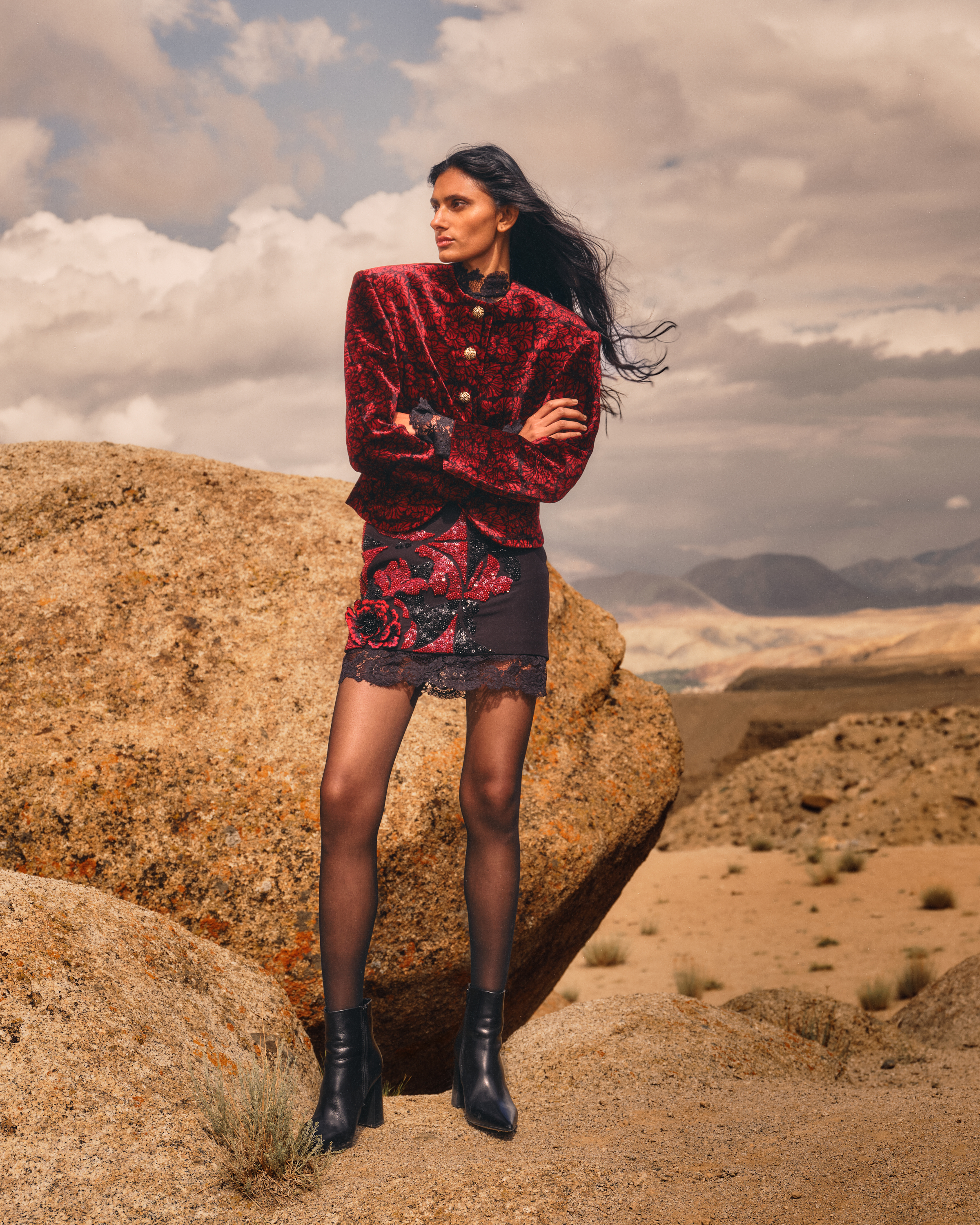
Inspired by Ladakh’s rugged mountains and delicate alpine blooms, Āroka’s latest collection, The Ascent, explores growth as a process of carrying every version of ourselves forward. Founder Shweta Agarwal speaks to Balcony Stories about the personal reflections behind the collection, reinterpreting Ajrakh on velvet and finding strength in softness.
There is a personal idea at the heart of The Ascent, the latest collection from Indian luxury womenswear label Āroka: every chapter of our lives contributes to who we become. For founder Shweta Agarwal, that thought takes shape through sculptural silhouettes, fluid draping and materials that bring the contrasts of Ladakh into contemporary occasion wear.
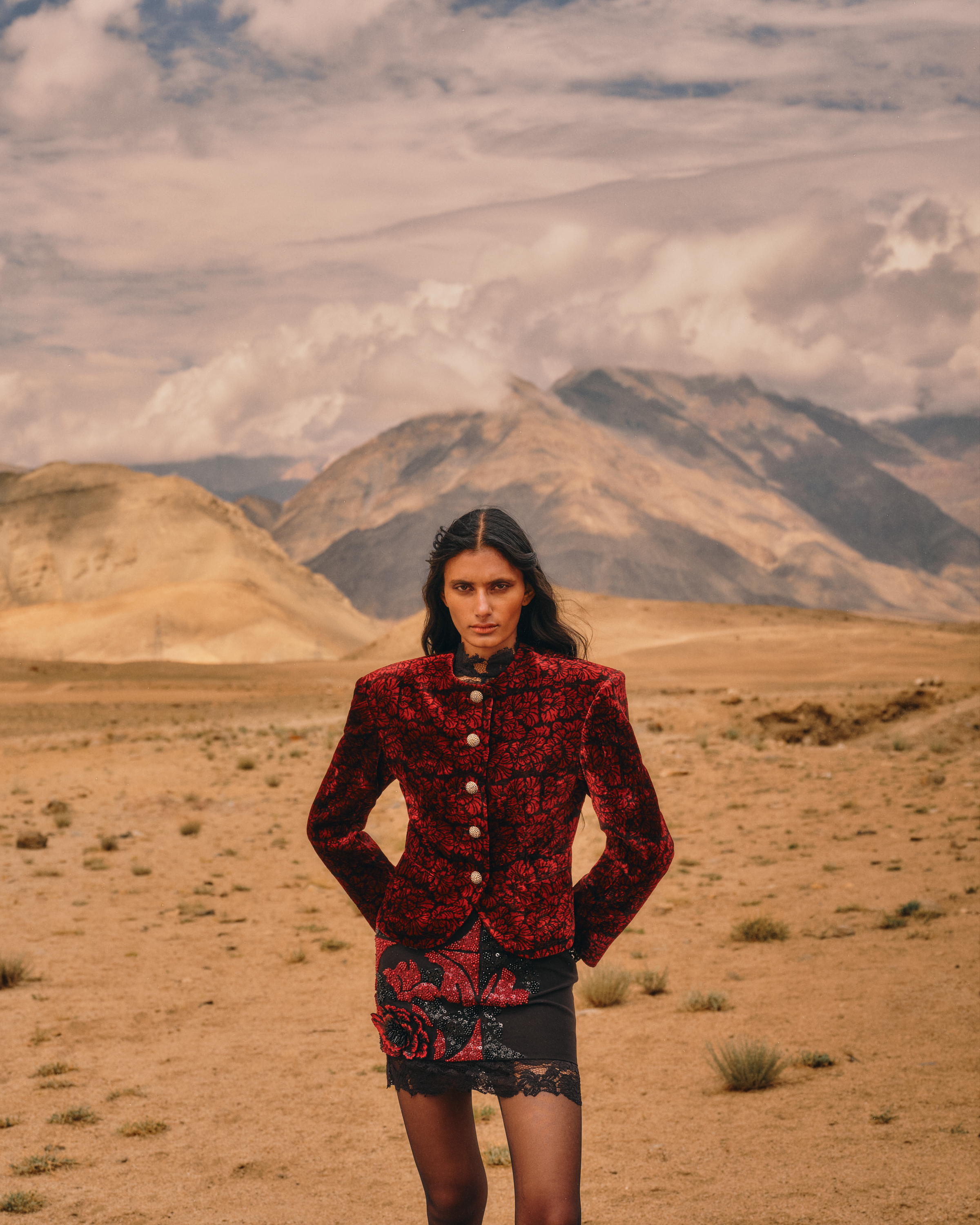
Intricate woven jacquards, dimensional embroidery and delicate cutwork lace sit alongside the label’s signature ruching and architectural construction. Ajrakh finds an unexpected expression on velvet, while a palette of monastery red, mountain shadow black, antique gold, sky blue and alpine blush draws from the Himalayan landscape. The accompanying campaign film follows a woman encountering different versions of herself on a symbolic ascent, giving visual form to the collection’s exploration of memory and transformation.
Founded in 2019, Āroka has built its design language around artisanal craftsmanship, hand-ruching and refined draping. With The Ascent, Agarwal brings that language into a conversation about resilience, vulnerability and the freedom to evolve. In this interview with Balcony Stories, she reflects on the collection’s beginnings and what both she and the label are still becoming.
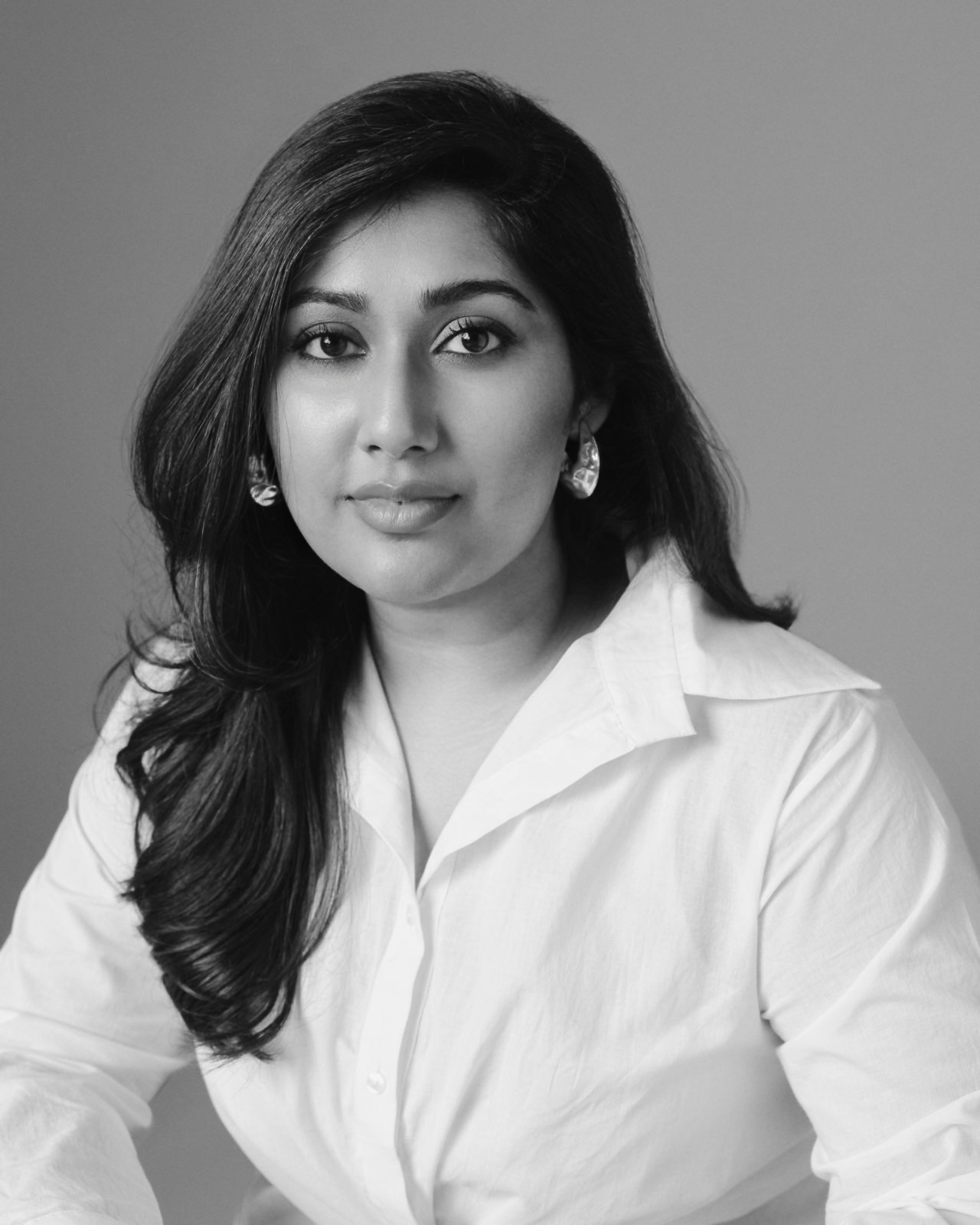
The Ascent explores becoming rather than reinvention. What was happening in your own life when this idea began taking shape?
I think I was at a point where I was becoming more comfortable with the idea that growth doesn’t always mean becoming someone new. Sometimes it is about understanding yourself more deeply and allowing different parts of who you have been to exist together. There was a sense of movement in my own life, personally and creatively and I wanted to explore that feeling through the collection. The Ascent came from that idea of moving forward without feeling the need to leave everything behind.
The collection honours every version of the self. Is there an earlier version of Shweta that you struggled to accept but now look back at with gratitude?
Definitely. There have been versions of me that were more uncertain and perhaps more concerned with proving myself. At the time, I saw those qualities as things I needed to overcome. Looking back, I realise they were also what gave me the courage to take risks and build Āroka in the first place. I have a lot more compassion for my younger self now. She was figuring things out with the understanding she had at the time.
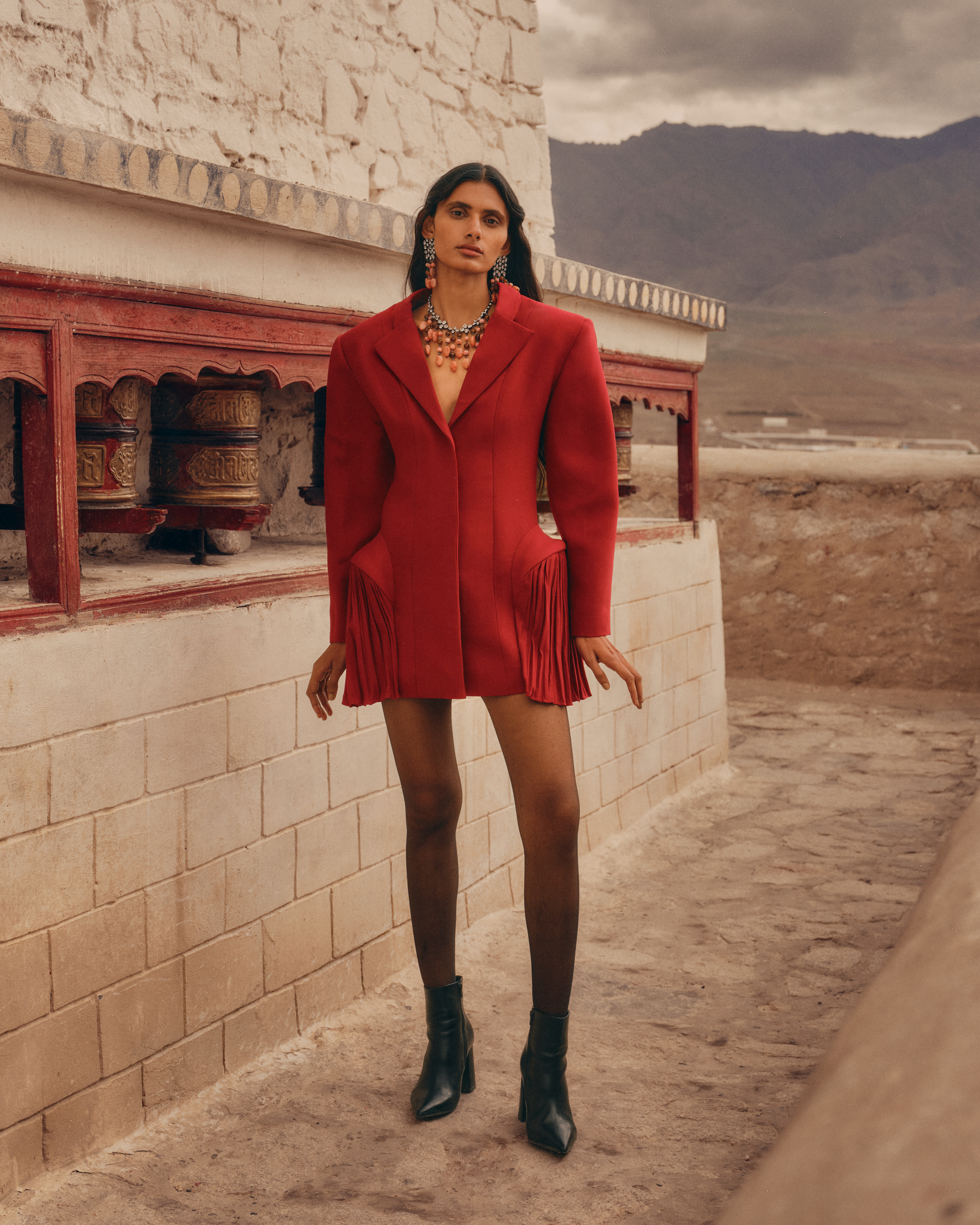
Ladakh is visually striking and frequently referenced in fashion. What did you want to capture beyond its obvious beauty?
I was less interested in photographing Ladakh as a beautiful backdrop and more interested in its feeling. There is something incredibly humbling about being surrounded by that scale, the mountains, the silence, the starkness, and the sense of time that seems to exist there. It makes you feel very small, but at the same time very present. I wanted The Ascent to carry some of that emotional quality rather than simply reproduce its landscape visually.
Was there one specific moment, texture or visual from Ladakh that became the starting point for the collection?
It was the contrast that stayed with me most, the severity of the mountains against tiny, almost unexpected moments of colour and softness. The monastery reds, the deep shadows, the blue of the sky, the weathered surfaces and the warmth of the golds all felt incredibly powerful together. That contrast eventually found its way into the palette and the materials of the collection.

How did you translate abstract emotions such as resilience, growth and vulnerability into silhouettes and fabrics?
I think clothing can communicate emotion without being literal. Resilience found its way into structure, strong shoulders, sculptural forms and pieces that hold their shape. Vulnerability came through softer draping, fluidity and fabrics that move with the body. Growth was about the relationship between the two: allowing softness and strength to exist in the same silhouette rather than treating them as opposites.
The Ascent balances softness with structure. Does that contrast also reflect the kind of woman you were designing for?
Very much so. I don’t think strength in a woman has to look hard, just as femininity doesn’t have to mean fragility. The woman I imagine wearing Āroka can be both. She can be sensual and restrained, grounded and constantly evolving. I wanted the clothes to give her that same freedom.
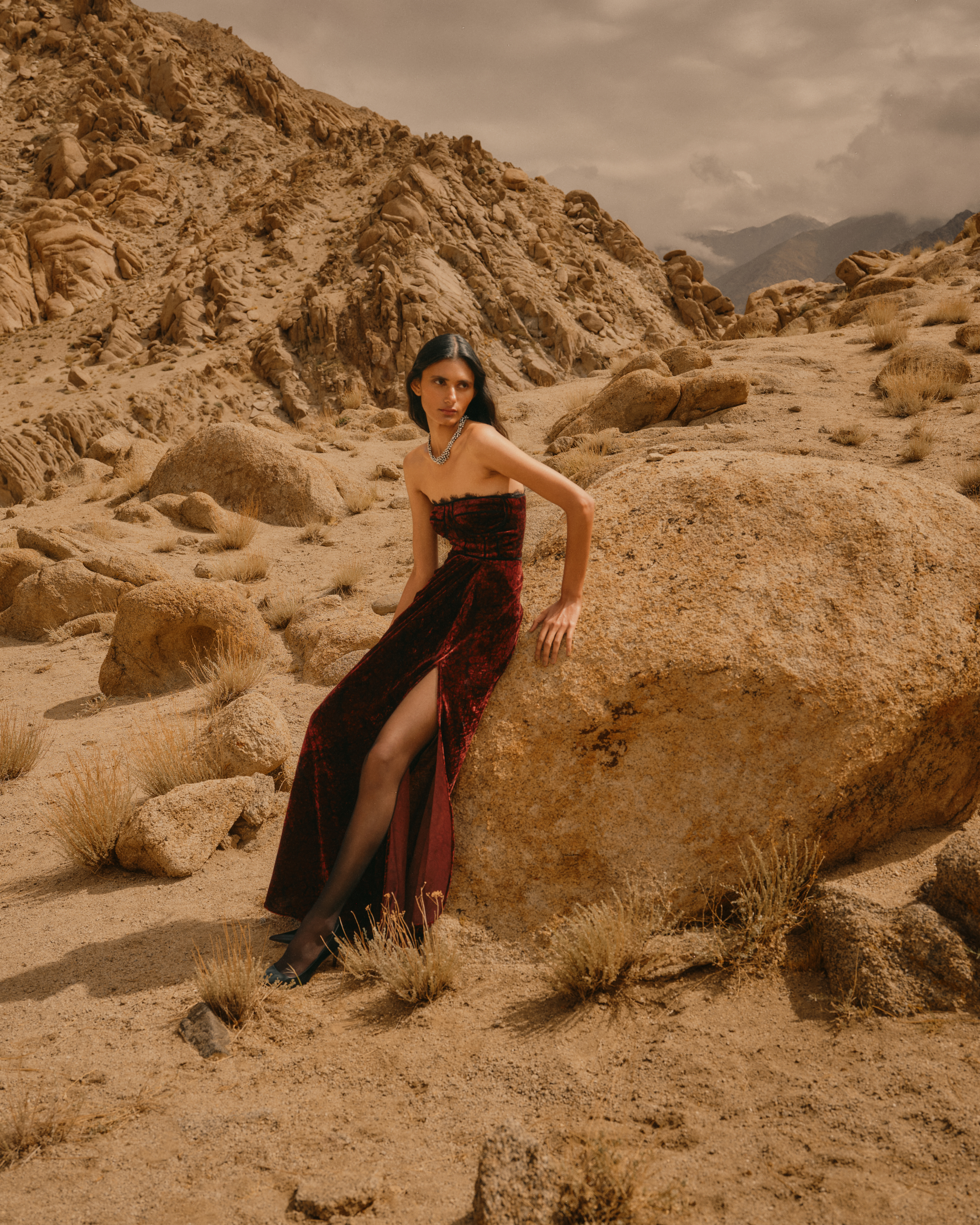
What inspired you to reinterpret Ajrakh on velvet, and what were the challenges of bringing together such different material traditions?
I have always been interested in taking something deeply rooted in Indian craft and placing it in a context that feels unexpected. Ajrakh has such a strong visual language and history, while velvet has this inherent richness and depth. Bringing the two together created a tension that felt right for The Ascent.
The challenge was in respecting the character of the Ajrakh while allowing it to work with the weight and texture of velvet. It required a lot of consideration around colour, scale and how the print would sit on a more luxurious surface. I wanted it to feel contemporary without losing where it came from.
Āroka is known for hand-ruching and sculptural draping. How do you keep a signature technique from becoming a predictable formula?
By not treating the technique as the identity of the garment. For me, ruching and draping are tools rather than formulas. I keep asking what the fabric and the silhouette need, and whether the technique is actually adding something to the piece. Sometimes the most important decision is knowing when not to use something you are known for.
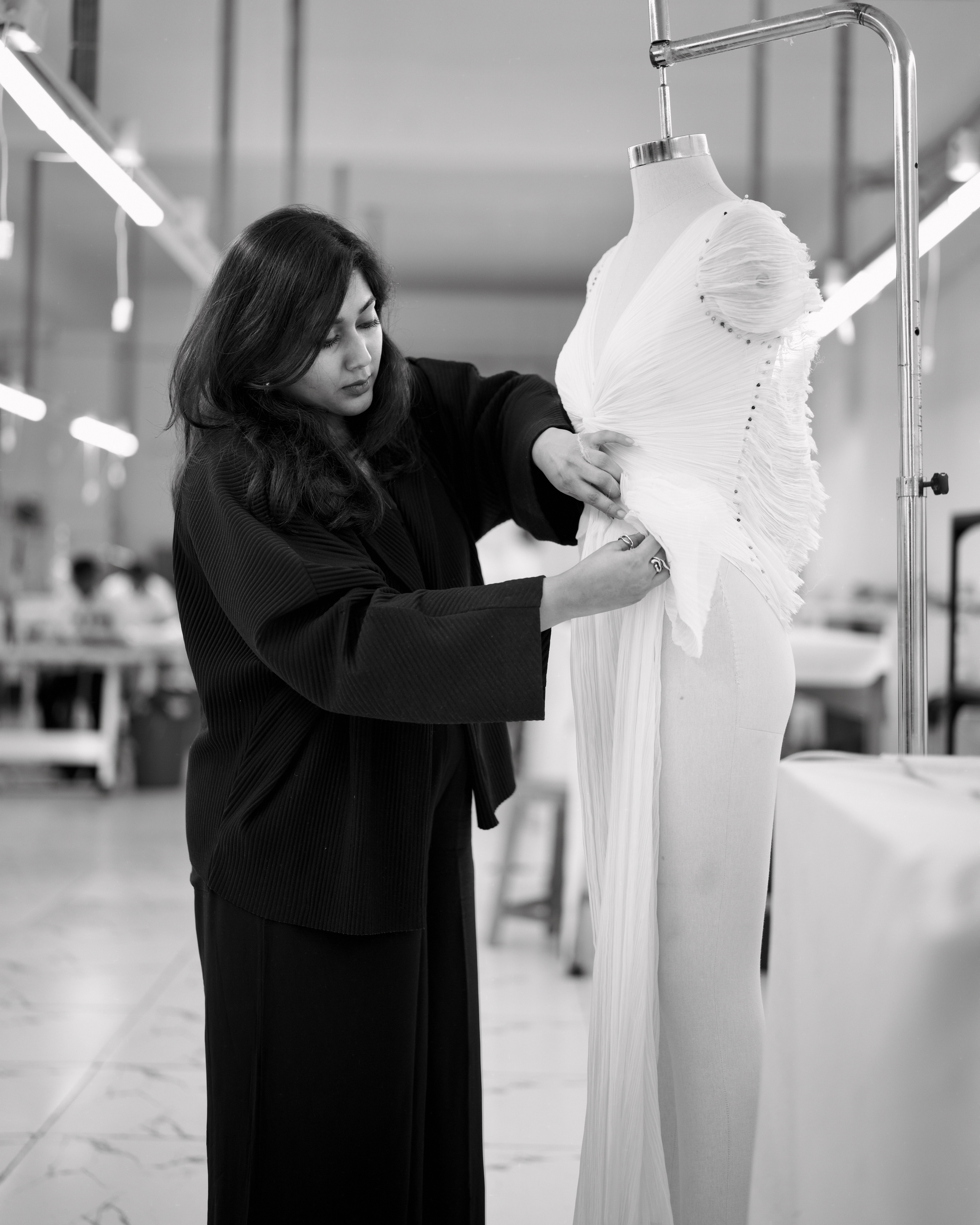
“Craftsmanship” has become a widely used luxury buzzword. What does genuine engagement with Indian craft look like to you?
For me, it begins with respect. Indian craft should not simply be treated as a decorative element that makes a garment look more luxurious. There has to be an understanding of the technique, the people behind it, the time it takes and the cultural context it comes from.
At Āroka, craftsmanship is also about creating something that gives the craft a meaningful place in contemporary life. We work in small batches and value the human hand in our process because we want the final garment to retain that sense of individuality. Luxury, to me, is as much about time, skill and intention as it is about the finished object.
Candidly, which piece gave you the most trouble—and was there ever a point when you wanted to abandon it completely?
The more sculptural pieces were definitely the most demanding. When you are trying to create a very specific architectural shape on the body, there is a fine line between something looking powerful and something simply looking constructed. There were several iterations where the proportions just weren’t right.

There is always a point during development where you wonder whether a piece is worth pursuing. But I’ve learnt that sometimes the difficult pieces are the ones that teach you the most. If the idea continues to stay with you, it usually deserves another attempt.
Do you personally wear everything you design? Which look from The Ascent feels most like you, and which one pushes you outside your comfort zone?
I don’t necessarily wear everything I design, but I do need to be able to imagine myself living in the clothes. For me, that is an important test, whether a garment has a life beyond the photograph.
The pieces that combine strong structure with a softer, more fluid element feel closest to me. They have the balance I naturally gravitate towards. The more overtly dramatic, sculptural silhouettes push me a little outside my comfort zone, but that is also what I enjoy about them. I think a collection should reveal something you already know about yourself as well as something you are still discovering.
After creating a collection about becoming, what do you feel Shweta and Āroka are still in the process of becoming?
I think both are still becoming more assured in their own language.
Āroka has evolved considerably since I started it, and I don’t see that evolution stopping. We are learning how to become more intentional about what we make, how we work with craft, how we build a luxury brand from India, and how we can grow without losing the intimacy and individuality that brought us here.
Personally, I think I am learning the same lesson, the next version of yourself doesn’t have to reject the previous one. You can carry it with you, learn from it, and still keep moving upwards.
With The Ascent, Shweta Agarwal brings a personal understanding of growth to Āroka’s contemporary luxury womenswear. Ladakh’s contrasts find expression in sculptural forms, fluid draping and the meeting of Ajrakh with velvet, giving the collection’s emotional foundations a tactile presence. Her reflections return to the thought that every stage of becoming has value. As Āroka continues to evolve, that belief connects the woman, the clothes and the craftsmanship: each carry something of where it began.
Read also
- ELIE SAAB x H&M Collection Brings Couture Glamour to the High Street
- Ganesh Chaturthi 2026 Fashion Guide: Festive Looks to Wear This Season (Sponsored)
- Post-Monsoon India Is Better Than Peak Season—Here Are the Trips to Take Before Everyone Arrives