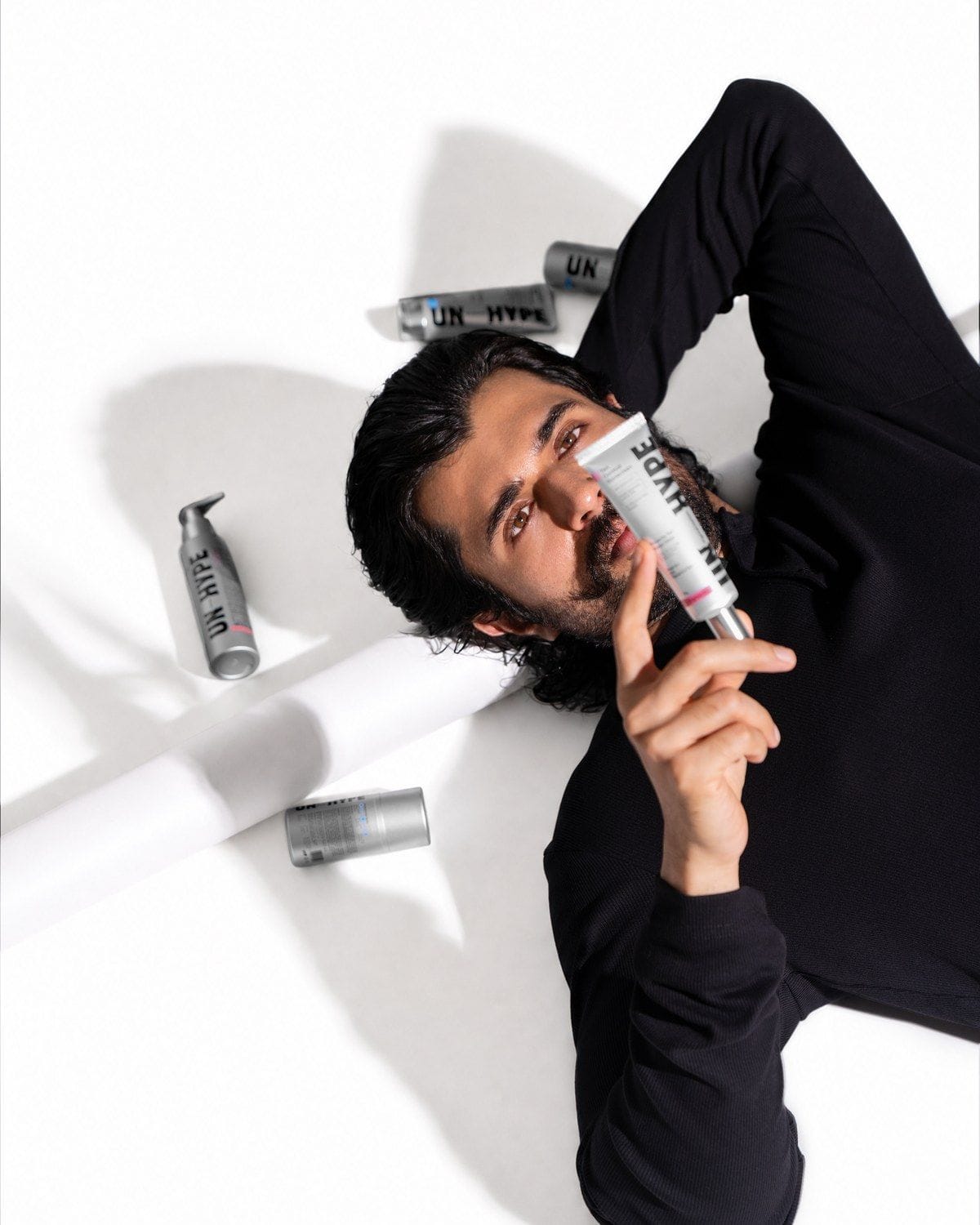
Featured image: Vijay Deverakonda for Unhype. Photo: Unhype.
There was a time when a celebrity-brand relationship could be explained in one photograph. A famous face stood beside a product, the company borrowed some star power, and an endorsement cheque completed the arrangement. That model is still very much alive. But alongside it, something more ambitious has taken shape: the celebrity who wants a stake in the business, a say in the product and a name on the founding team.
Vijay Deverakonda’s Unhype makes the shift particularly visible. On its official website, the skincare company presents the actor as a co-founder and says he spent nine months testing successive formulations on his own skin. That is the brand’s account of his involvement, rather than independent proof of product performance. But the message is revealing: this is meant to be a business he helped build, not simply another bottle he has been photographed holding.
The rise of celebrity-founded brands in India raises a more interesting question than which actor is launching what next. Who began turning fame into a consumer business here, and how did the journey move from restaurants and slogan T-shirts to skincare laboratories, jewellery labels and protein snacks?
Who started the celebrity-brand concept in India?
There is no reliably established single first. The answer changes depending on whether we mean a celebrity owning a business, lending a name to a licensed product, founding a retail label or investing in someone else’s company. Actors were building production businesses long before anyone described a moisturiser launch as a direct-to-consumer opportunity. Calling a recent beauty founder the inventor of celebrity entrepreneurship would erase that history.
Even outside entertainment production, the idea predates Instagram. Sachin Tendulkar’s restaurant venture with hotelier Sanjay Narang was being reported in 2002. It offered an early version of a proposition that now feels familiar: take the public’s affection for a star and translate it into an experience people can buy. The celebrity brought recognition; an experienced operating partner brought the practical machinery of hospitality.
For the modern consumer-label wave, Salman Khan’s Being Human and Hrithik Roshan’s HRX are useful landmarks rather than candidates for an uncontested first-place trophy. Being Human’s charitable foundation dates to 2007; the clothing business came later, launching internationally in 2012 through a licensing arrangement with Mandhana. Those are separate milestones. The distinction matters because a charity, a licensed clothing label and the company making its garments are not interchangeable entities.
HRX, launched in 2013, took a different route through fitness. Its connection with Roshan’s public image was easy to understand. The aspiration was something a customer could participate in through clothing and exercise, rather than merely admire on screen. That is an important evolution in the story: celebrity identity becoming a repeatable product proposition.
The fashion wave made celebrity labels familiar
By the end of the 2010s, the field was crowded. The wave included Virat Kohli’s Wrogn and one8, Deepika Padukone’s All About You, Anushka Sharma’s Nush, Sonam and Rhea Kapoor’s Rheson, Shahid Kapoor’s Skult, Tiger Shroff’s Prowl and Jacqueline Fernandez’s Just F. Sachin Tendulkar’s True Blue, Saif Ali Khan’s House of Pataudi and Shikhar Dhawan’s Da One showed how the idea could stretch into occasion wear and home furnishings.
That is a record of the wave, not a claim that every label retains its original ownership, partnerships or retail footprint today. What linked these ventures was a commercial opportunity: sell a recognisable taste, attitude or way of living, while retail partners handled much of the infrastructure. The star could make the first introduction feel personal. The business still had to deliver an appealing product at a workable price.
Fashion was a natural starting point because fans already watched celebrities for what they wore. A familiar silhouette or styling choice could become a collection. Yet that same advantage carried a limitation: a shopper might like a particular outfit without developing any loyalty to the label behind it. The next wave would move into categories where routine and repeat purchases could matter more than a seasonal wardrobe refresh.
Why beauty became the celebrity-founder favourite
Katrina Kaif’s Kay Beauty, launched with Nykaa in 2019, sits at the centre of that transition. The partnership connected a celebrity’s experience of makeup with an established beauty retailer’s reach. Its later expansion into the UK through Space NK also shows how the ambition can extend beyond a domestic fan base.
Beauty offers an unusually intimate founder narrative. A celebrity can explain what they wanted from a shade, texture or finish and why an existing product disappointed them. That does not automatically make the finished formula better. It does, however, create a more detailed story than the conventional claim that a famous person happens to use it.
Deepika Padukone followed with 82°E, co-founded with Jigar Shah and launched in 2022. Kriti Sanon’s Hyphen similarly places her within a named founding team rather than presenting her only as a campaign ambassador. Look beyond the celebrity photographs on such pages and another part of the story appears: the people responsible for supply, finance, growth and day-to-day execution.
That supporting team is essential. A founder can bring customer insight and help define the product without personally being a formulation scientist or running a factory. The useful question is not whether the star performs every function. It is whether their involvement adds something specific, and whether qualified people are accountable for the functions they do not perform.
Unhype now brings Deverakonda into the same conversation. Its positioning emphasises straightforward routines and Indian conditions, while its founding story stresses testing and product involvement. The commercial challenge remains the one every skincare company faces: persuade people to try the first bottle, then give them a reason to buy the second. Personal testing by a celebrity and evidence of effectiveness across customers are different things.
Read more: More business stories from The Balcony Stories
The map now reaches beyond Bollywood beauty
The wider landscape makes it clear that this is not simply a Hindi-film-industry phenomenon. Samantha Ruth Prabhu’s Saaki, built with Sushruthi Krishna, brought a celebrity-led proposition into ethnic fashion through a partnership combining public recognition and retail experience. Nayanthara’s 9Skin is another example of the beauty category drawing founders from across Indian cinema.
Ranbir Kapoor’s ARKS, launched in 2025, takes the discussion back to everyday clothing, footwear and lifestyle. The launch collection centred on sneakers, clothing and accessories. Ranveer Singh’s SuperYou, created with Nikunj Biyani, moves into packaged nutrition and snacks. Different categories bring different purchase habits: a sneaker may be an occasional indulgence, while a snack has to earn space in a much more frequent routine.
Jewellery adds another variation. Shraddha Kapoor’s association with Palmonas came after the company’s original establishment by Pallavi Mohadikar and Amol Patwari. It is a reminder that a celebrity can join an existing venture with a co-founder designation. The word alone does not tell readers when the business began or how its ownership is divided.
Alia Bhatt’s Ed-a-Mamma expands the picture into children’s clothing, while Priyanka Chopra Jonas’s Anomaly represents the international haircare route. Taken together with HRX, Being Human, Kay Beauty, 82°E and the earlier fashion labels, these examples show how broad the category has become. They are a substantial cross-section of the movement, rather than an exhaustive register of every Indian celebrity investment or commercial partnership.
Founder, investor and licensed name are different jobs
This is where the language around celebrity business can become slippery. An ambassador is generally paid to promote a brand. An investor owns a financial stake. A founder helps establish the venture. A licensing arrangement allows a business to use a name, identity or other intellectual property under agreed terms. A joint venture brings partners together in a shared enterprise. One person can occupy several of these positions, but none should be assumed from a launch photograph.
For readers, the distinction changes how a claim should be understood. An equity stake may give a celebrity an economic interest without giving them control over manufacturing. A prominent founder title does not reveal their shareholding. A licensed label can be a substantial business without the star supervising its daily operations. These are different structures, not a simple ranking of authenticity.
It also explains why describing every product associated with an actor as celebrity-owned can be misleading. A business may begin with a celebrity and later be sold, restructured or absorbed into a larger retailer. The origin story can remain visible long after the ownership story has changed.
The exits tell us as much as the launches
Ed-a-Mamma offers a concrete example. Founded in 2020, the company attracted Reliance Retail Ventures, which announced a 51 per cent stake in September 2023. The significance is not simply that another celebrity had a clothing line. An established retailer saw a business it wanted to develop through a majority partnership.
Deepika’s earlier fashion venture illustrates why historical labels need updating. Myntra acquired full ownership of All About You in 2020. It belongs in the history of celebrity-founded brands, but that history should not be confused with a statement that Padukone still owns it.
There is a more recent example too. Reliance’s official announcement details its April 30, 2026 acquisition of Anomaly’s trademarks, brand assets and digital properties. Chopra Jonas continues as creative director. For a reader encountering an old roundup of celebrity-owned beauty companies, that is a material update. For the broader story, it demonstrates that ownership can change while the celebrity origin remains part of a brand’s identity.
An acquisition is not, by itself, proof that every founder made an extraordinary return. Purchase terms, previous investment and remaining obligations matter. But it does help explain the attraction of equity: a celebrity is seeking participation in the value of an enterprise, rather than only payment for the next campaign.
What fame can buy—and what it cannot
The obvious advantage is attention. Most new businesses have to spend heavily just to introduce themselves. A celebrity can arrive with an audience already listening. Their interviews, public appearances and social feeds can create opportunities to explain the product. That head start is powerful, but it should not be confused with a permanently low cost of acquiring customers.
Followers are not automatically shoppers, and shoppers are not automatically repeat buyers. A launch can attract curiosity, admiration and criticism in equal measure. Once the first wave passes, the company must still manage pricing, inventory, delivery, customer service and competition. A popular founder cannot make an uncomfortable shoe fit better or make a disappointing lipstick a favourite through visibility alone.
The strongest conceptual fit is often easy to describe. Fitness connects naturally with Roshan’s public identity. Makeup connects with Kaif’s professional experience. Yet even a convincing match should be treated as a reason to understand the proposition, not a substitute for judging the product. Celebrity proximity is useful marketing; it is not an independent quality standard.
There is also a tension inside the founder story. The more a company insists that its products are inseparable from one famous person, the harder it may find it to expand beyond that person’s audience. Building something durable can eventually mean allowing designers, scientists, operators and satisfied customers to become as important to the story as the launch-day face.
Read more: Explore our Entertainment coverage
From borrowed fame to a business that can stand alone
The shift is therefore about more than celebrities wanting a different kind of cheque. Ownership offers a way to turn professional visibility into an asset that could outlast a film release, a playing career or a particular moment of cultural relevance. It also introduces business risk, continuing responsibilities and the possibility that the venture will not work.
India’s celebrity-founder story did not begin with Unhype, and it will not end with the next skincare announcement. It has moved through restaurants, licensed clothing, fitness labels, marketplace partnerships, beauty businesses, children’s wear, jewellery and food. Some ventures will expand. Some will change hands. Others may survive mainly in old launch stories.
The meaningful test is what remains once the celebrity introduction has done its job. Can the company explain why its product belongs in somebody’s life? Can it deliver consistently? Would customers still return if the founder’s photograph disappeared from the homepage?
An endorsement asks a star to help sell a product. A lasting celebrity-founded business eventually has to give that product a life of its own. In a market crowded with famous founders, that may be the most valuable form of independence there is.